
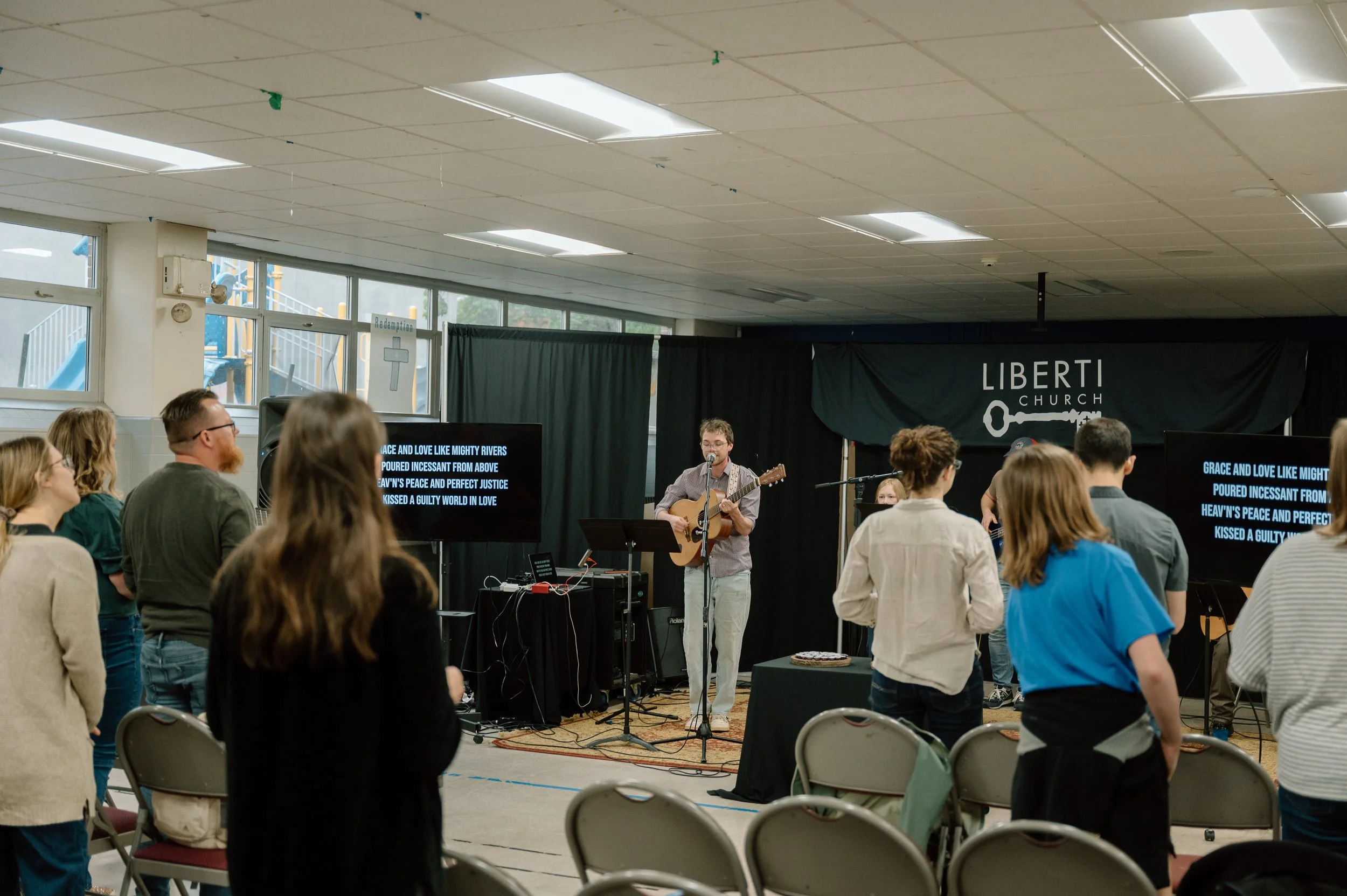
WHY WORSHIP?
Our Sunday morning gatherings are the central way that we are spiritually connected and nourished together as a church family.
We get our word “worship” from a contraction of an old-English word: “worth-ship”. Worship is the process by which we call things worthy or valuable. Broadly speaking, all of life is a process of worshipping something; of saying to ourselves and others, “this matters". But as Christians we reserve our ultimate worship for God because he is supremely valuable. All of the worship at Liberti Fairmount is designed to focus our minds and hearts around the person of Jesus Christ. We do this through a mixture of singing, confession, prayer, the reading and exposition of Scripture, offering, creed, and the Lord’s Supper.
Liberti Church Fairmount is the first congregation of the Liberti Communion of Churches and is also a member of Gospel Coalition.
Liberti Fairmount Playbook
(Updated September 2025)
1. Why Do We Exist?
(underlying reason for being Liberti Fairmount; our core purpose)
We exist to live out the freedom we have in Jesus Christ and to offer that freedom to others.
Listen to a sermon on freedom in Christ here
2. How Do We Respond to the Freedom that We Have?
(the ultimate guide for behavior at all levels of involvement at Liberti Fairmount; principles that guide our behaviors and decisions over time)
Existing Values
(a few -just two or three- behavioral traits that are already inherent in Liberti Fairmount)
We are free in Christ to be…
1) Hospitable - we are hospitable to each other and welcoming those who have yet to embrace Christianity but are willing to have their questions, doubts, and struggles both honored and addressed.
2) Communal - we cultivate community where people are called to see themselves and each other not as consumers of “church" but as present members in the body of Christ.
3) Encouraging - we encourage one another in our lives and faith
Aspirational Values
(characteristics that Liberti Fairmount wants to have, wishes it already had, and believes it must develop)
We aspire in our freedom in Christ to be…
Honest - we admit that we are broken in our faith and depend on the Lord through His People
Bold - we admit that we are set aside for God and are unafraid to live life in a manner worthy of Him.
Discerning - we challenge one another to grow in our faith
Cultural Values
(the minimum standards that are required in Liberti Fairmount)
Our freedom in Christ means...
Participation - we contribute to the life of the church with our time, talent, and treasure.
Balance - we are casual but intentionally engaged
Diversity - we are comfortable in relationships across different life stages.
Liturgy - we narrate the movements of the Gospel and benefit from the riches of historic Christian worship
(that we are) Winsomely Reformed - we are led by pastors and elders that embrace the Reformed articulation of the Christian faith while seeking to live with humility and gratitude as we learn from other faithful traditions in the body of Christ.
Accidental Values
(traits that are evident in Liberti Fairmount, but have come about unintentionally and are not necessarily good for the church; behavioral tendencies that have developed over time because of history, or because staff with a similar background have been hired, etc.)
Lack of punctuality - we are late to everything
Listen to a sermon on our values here
3. What we do
(a clear and straightforward answer to “what?”)
We worship God, live in community throughout the week, and serve neighbors in need.
(“Live, speak, and serve as the very presence of Jesus”)
Listen to a sermon on what we do here
4. How will we succeed?
Strategy, or simply put, Liberti Fairmount’s plan for success; a collection of intentional decisions the elders make to give the church the best chance to thrive; every single decision, if it is made intentionally and consistently, will be part of the overall strategy.
Strategic Anchors:
Boil down the plan for success to two strategic anchors that will be used to inform every decision the church makes and provide the filter or lens through which decisions must be evaluate to ensure consistency; provide the context for all decision making.
Long Term Anchor: God’s Presence - God fills us fully with his presence and we are built up, encouraged, consoled, with anyone joining us able to declare that is really among us.
Ephesians 3:19…that you may be filled with all the fullness of God
1 Cor 14:3-4, 12, 24-25 … 3 ...the one who prophesies speaks to people for their upbuilding and encouragement and consolation. 4 ...the one who prophesies builds up the church... 12 So with yourselves, since you are eager for manifestations of the Spirit, strive to excel in building up the church...24 …if all prophesy, and an unbeliever or outsider enters, he is convicted by all, he is called to account by all, 25 the secrets of his heart are disclosed, and so, falling on his face, he will worship God and declare that God is really among you.
Key Result: God Is Tangibly Present In Our Lives, Both Individually And Corporately.
We, along with others from our neighborhood community, regularly experience God’s presence and love, both corporately as well as individually; we are built up, encouraged, and consoled by the Holy Spirit. We are a community where anyone joining us is able to declare that “God is really among you.”
Short-term Anchor: Invitation - we develop a culture of invitation through using our gifts well together
Romans 12:6-8 6 Having gifts that differ according to the grace given to us, let us use them: if prophecy, in proportion to our faith; 7 if service, in our serving; the one who teaches, in his teaching; 8 the one who exhorts, in his exhortation; the one who contributes, in generosity; the one who leads, with zeal; the one who does acts of mercy, with cheerfulness.
Key Result: We are stronger using our distinct and complementary gifts together as a body, than we are as separate individuals trying to do too much, so that we take joy in the ways in which we serve, and it is easy for current members, attendees, and visitors to participate by also using their gifts for the Lord in our neighborhoods.
Listen to a sermon on how we will succeed here
5. What is most important now?
(For Liberti Fairmount to create a sense of alignment and focus, it must have a single top priority within a given period of time; for something to be the top priority, it has to be more important than everything else; even if there are multiple big priorities, ultimately one of those has to be at the very top.)
Top Priority: Reassembling The Diaconate
A Vision for What We’re Building Together
Why This Exists
Liberti Fairmount exists to live out the freedom we have in Jesus Christ and to offer that freedom to others. One of the most tangible ways we do that is through mercy ministry — meeting real needs in real lives, as an expression of the gospel we’ve received.
As Tim Keller puts it: “Mercy to the full range of human needs is such an essential mark of being a Christian that it can be used as a test of true faith. A life poured out in deeds of mercy is the inevitable sign of true faith.” — Timothy J. Keller, Ministries of Mercy: The Call of Jericho Road (P&R Publishing, 2nd ed., Phillipsburg, NJ, 1997), pp. 35–66
The gospel is the wellspring of all mercy ministry. We were ourselves spiritually bankrupt, alienated from God with no resources to help ourselves — and Christ impoverished himself so that we might be rich (2 Corinthians 8:9). He is the Great Deacon (Romans 15:8), who identified with the poor and vulnerable, crossed every barrier of race and class and custom, and poured himself out in costly, practical love. Mercy is not an obligation imposed on Christians from the outside — it is the natural overflow of people who have truly understood what has been done for them. We give because we have been given to. We serve because we have been served.
What We’re Pursuing: Shalom
Shalom is God’s comprehensive flourishing — peace, wholeness, and dignity extended to every dimension of human life. At Liberti Fairmount, we pursue shalom personally, locally, and regionally across ten domains of human need.
Each of these ten domains reflects an arena of human need and divine healing. They map onto the four-fold fragmentation that sin introduced in Genesis 3 — alienation from God, from self, from one another, and from creation itself. Shalom is the reversal of all four. The ten domains are the practical terrain on which that reversal happens: they form the shared structure for diaconal discernment, initiative planning, and prayer.
💧 Water
A gift of creation that sustains life and symbolizes cleansing, renewal, and the Spirit’s flow. (Water signifies both physical provision and spiritual rebirth — Genesis 2, John 4, Ezekiel 36, John 7.)
John 4:13-14; Psalm 104:10-13; Ezekiel 36:25-26; Revelation 22:1-2
Rain Check Program — stormwater tools & rebates (up to $2,500); TAP — Tiered Assistance Program — water bill assistance, (215) 685-6300; DHCD; Basic Systems Repair Program — plumbing repair, 215-448-2160
🏠 Shelter
God’s protective presence made tangible — providing safety, dignity, and belonging. (Shelter images both divine refuge and human hospitality — Psalm 91, Isaiah 58, John 14.)
Psalm 91:1-2; Isaiah 58:7; Psalm 27:5; John 14:2-3
Homeless: Office of Homeless Services; I.D. Philly — Broad Street Ministries; Help when facing homelessness; Homeless Intake Process — Renter: TURN — free counseling, (267) 443-2500; Help with paying rent; Right to Counsel; Emergency Relocation Services — Homeowner: Tangled Title Fund — grants up to $6,500; Restore, Repair, Renew — loans up to $50,000; Save Your Home Hotline — (215) 334-4663
🗑️ Waste
God’s call to steward creation, reject excess, and transform disorder into fruitfulness. (Waste encompasses physical pollution and spiritual disintegration — Genesis 2:15, Mark 7, Leviticus 19.)
Genesis 2:15; Matthew 15:37; Mark 7:15-23; Leviticus 19:9-10
Philadelphia Department of Sanitation — All Services
🏥 Health
Embodied wholeness that reflects God’s healing heart for body, mind, and soul. (Jesus’ healing ministry reveals the kingdom’s arrival — Matthew 11, James 5, Exodus 15.)
Matthew 11:4-5; Luke 10:8-9; James 5:14-15; Exodus 15:26
Philadelphia Renewal Network (PRN) — Christian counseling, (215) 222-0310, discounted rates available; Counseling — financially supplemented based on need (internal diaconate fund)
✝️ Spirit
The indwelling presence of God forming a holy people through worship, prayer, and transformation. (From temple to Church, God makes his home in us — John 4, Acts 2, Revelation 21:3.)
John 4:23-24; Ezekiel 36:26-27; Acts 2:1-4; Revelation 21:3
Liberti Church; Faith-Based and Interfaith Affairs — City of Philadelphia — (215) 686-2191, FaithPHL@phila.gov; Mayor’s Interfaith Roundtable
🤝 Community
The body of Christ formed by love, joined in mutual care, and reconciled across difference. (Acts 2 and 1 Cor. 12 portray Spirit-shaped togetherness rooted in the Trinity.)
Acts 2:42-47; Hebrews 10:24-25; 1 Corinthians 12:12-27; Ephesians 4:15-16
AlphaCare Philadelphia — pregnancy support, 3807 Lancaster Ave, (215) 545-4673 — Education (building community through learning): Preschool Cooperative; City School Philadelphia — K–8, Middle, High; Bache-Martin School — neighborhood K–8; Robert Morris School — neighborhood K–8
⚖️ Justice
God’s justice sets all things right — through judgment, restoration, and equity — flowing from His righteousness into covenantal relationships and public structures. (Retributive: Romans 13:4, Deut. 32:35 / Restorative: Isaiah 58, Luke 4:18-19 / Distributive: Leviticus 25, Acts 2:44-45 / God’s Character: Psalm 89:14)
Micah 6:8; Amos 5:24; Isaiah 1:17; Psalm 85:10-11
Safety and Justice Challenge — Philadelphia
💼 Livelihood
Work as worship — sharing in God’s creative activity through meaningful, dignified labor. (From Eden to Thessalonica, Scripture affirms good work as vocation — Genesis 2, Colossians 3, 2 Thessalonians 3.)
Genesis 2:15; Colossians 3:23-24; Proverbs 31:13-31; 2 Thessalonians 3:10-12
Philadelphia Skills Initiative; OIC of America — Philadelphia; Philadelphia Career Pathways; Free Library — Career Training
🍞 Food
A means of nourishment, joy, and hospitality — reminding us of God’s abundance and shared table. (Feeding the hungry is both literal mercy and a sign of the kingdom — John 6, Isaiah 55, Matthew 25.)
Matthew 25:35; John 6:35; Isaiah 55:1-2; Acts 2:46-47
Free Food & Meal Finder; Philabundance; Broad Street Ministries; Small Things Philly; Small Things Market — Volunteer; BenePhilly; SNAP; PA COMPASS — apply for Medicaid, SNAP & more
⚡ Energy
God’s empowering presence made visible through creation, mission, and wise stewardship. (Energy represents power for light, labor, and life — from oil lamps to resurrection life — Matthew 25, Acts 1:8, Isaiah 40.)
Matthew 25:1-13; Luke 8:46; Acts 1:8; Isaiah 40:29-31
Help Paying Utility Bills; LIHEAP; BenePhilly; PECO Low Income / LIHEAP; PGW LIHEAP / Crisis & Hardship Grants; Cooling Sites; Warming Sites / Code Blue; Basic Systems Repair Program — electrical, plumbing, heating
Philadelphia already has remarkable resources in every one of these domains. The work of a deacon is largely to know what exists, know who needs it, and connect the two — with warmth, without bureaucracy.
What Deacons Actually Do
Deacons serve in three directions at once:
• Inward — Practical and responsive care for our own church family: noticing needs, organizing help, making sure no one falls through the cracks
• Outward — Mercy ministry to neighbors and the poor beyond our walls, extending Christ’s love to those who don’t yet know him
• Upward — Cultivating personal communion with God in it all — because the only lasting motivation for mercy is an experience of the grace we’ve received
The Good Samaritan is our model: costly personal involvement, practical deeds, and both immediate relief and long-term care.
Where We Are
We are in the season of reassembling the diaconate — it is our top near-term priority as a congregation right now. We have the theological foundation, and identified the resource network, and some potential partnerships. What we need are people with the time, the wisdom, and the heart to help organize what already exists and begin caring for people with it.
Opportunity To Lay The Groundwork:
We’re seeking those who would be willing to help us lay the groundwork — learning the resources, building the intake process, and beginning to serve as a point of contact for neighbors and members in need.
It will take maturity, availability, life experience, and a heart for people. The freedom we have in Christ is meant to be given away. This is one of the most beautiful ways to do that.
“The one who does acts of mercy, with cheerfulness.” — Romans 12:8
Listen to a sermon on what is most important now here.
6. Who is doing what?
Worshiping God
Before Sunday Worship
Setup Team - Scott Baber
Open Church, Playground, and Locked Storage Closet
Ensure volunteers are scheduled, setup chairs, curtain divider, signs, roll out music storage cabinets and gear, hospitality cart, Liberti Kids check-in station and classrooms
Order Uber Wave for Mike and assist with wheelchair entry
Preaching, Teaching, Liturgy - Scott Crosby
Prepare sermon, liturgy and notes for liturgists, finalize slides for worship, recording equipment ready capture the service; develop teaching notes for slides; prepare one page outline of teaching notes for person advancing the slides during service
Get announcements and teaching notes to Samantha for Slides
Music - Ben Greenman
Gather musicians, select songs and update slides, rehearse musicians, setup music gear.
Call time Sunday Morning 8:00 am
Rehearsal 8:30-9:30
Liberti Kids - Scott Baber & Lead Volunteers
Gather volunteer leaders for each of the classes, organize yearly scope and sequence for curriculum and distribute lesson guides and materials ahead of time, train setup team on setting up the check-in station and each classroom, obtain and monitor volunteer safety clearances, communicate updates and the Big Ideas of our lessons with parents and volunteers
Liberti Youth - Ben Greenman
Coordinate with Scott for sermon notes and create a youth-friendly notetaking guide for the sermon
Gather volunteers and distribute materials and lesson guides for a once a month gathering during the Sunday service
Communicate with volunteers and families about any upcoming events for the youth outside of Sunday morning
Hospitality - Diana Smith
Gather volunteers, including greeters, coffee station baristas, and others to help setup.
Prepare communion supplies for the service and set out
Gather particularly gifted people to welcome newcomers and get their information so that we can reach out to greet and welcome them directly
Living in community throughout the week
Before, During, and After Living In Community Throughout The Week
Group Life in 2025-2026
Consistent Groups
Fairmount
Monday 6-8PM - Passage from Sunday Study | Justin Smith and Kari Baber, Leaders
Brewerytown
Wed 6-8PM - Spiritual Disciplines Study | Haedi and Paul Thelen, Leaders
Thursday 6-8PM - Matthew Study | Alex McBride and Ben Greenman, Leaders
Other
6:8 Youth 1xMos | Ben Greenman, Leader
Intermittent Groups
Men’s Retreat
Men’s Fire Nights
First Fridays - Brewerytown and Audubon, N.J.
Women’s Retreat
Women’s Get-to-gethers
Serving neighbors in need
City School Garden - Pastor Scott (w/City School Staff)
AlphaCare - Diana and Ben
Small Things - Diana and Ben

WHAT MAKES A LIBERTI CHURCH?
Our Communion recognizes certain historic confessions, catechisms and creeds, such as the Apostles Creed and Nicene Creed, which the Church has affirmed across the centuries as helpful summaries of the essence and activity of God.
Our Statement of Faith is adapted and borrowed from the Gospel Coalition Statement of Faith.
Our Core Values flow from the gospel of Jesus and shape how we relate to God in worship, to each other in community, and to the world in mercy. We consider these values a part of the foundational Gospel calling for all Liberti Churches
ΚΟΙΝΩΝΊΑ
We call ourselves a Communion of Churches in recognition of the Greek word “Koinonia” and how it depicts our calling to “oneness” in the body of Christ, across many local expressions of the church. We believe that by accepting the invitation of communion with the Triune God, comes the expectation of sharing, investing, and partaking in communion with one another as brothers and sisters. We believe these two aspects of communion are inextricably connected in the Christian faith; and it is this belief that impacts the way we as a network of churches seek to live, speak, and serve as the presence of Christ for our region, and our world, as well as our local neighborhoods and communities.
“We cannot love God unless we love each other, and to love we must know each other. We know Him in the breaking of bread, and we know each other in the breaking of bread, and we are not alone any more. Heaven is a banquet and life is a banquet, too, even with a crust, where there is companionship. We have all known the long loneliness and we have learned that the only solution is love and that love comes with community.”
- Dorothy Day, The Long Loneliness: An Autobiography
“ ‘Koinonia’ expresses a common life as Christian men and women and it bears witness to two complimentary truths. On the one hand, it bears witness to what we share in together. And What is that? Well, it is the Grace of God…It also expresses what we share out together. Koinonia is the word that Paul used for the collection that he was organizing among the Greek churches for the benefit of the poverty stricken churches in Judea.”
- John Stott, Marks of a Renewed Church
HOW DO WE PRACTICE ΚΟΙΝΩΝΊΑ?
In Our Worship
Gospel Centrality We see all of life, the scriptures, and the church through the lens of the gospel. We teach with the understanding that all of the scriptures point to Jesus, who is the fulfillment of all God’s promises. It is the good news of Jesus that motivates us to live, speak, and serve as his very presence––and not moralism, intellectualism, or mere experience.
Winsomely Reformed We are led by pastors and elders that embrace the Reformed articulation of the Christian faith while seeking to live with humility and gratitude as we learn from other faithful traditions in the body of Christ.
Contextualized We seek to reflect the various communities in which we gather, live, and serve, rooting ourselves in the particular place and context that God has placed them in.
Liturgical We rehearse and narrate the movements of the Gospel in our worship gathering, and we seek to benefit from the riches of historic Christian worship and to express these riches in our worship gatherings.
Hospitable We are hospitable, welcoming those who have yet to embrace Christianity but are willing to have their questions, doubts, and struggles both honored and addressed.
In Our Community
Covenantal We cultivate community where people are called to see themselves and each other not as consumers of “church" but as covenantal members in the body of Christ.
Partnership We are committed to working together with other Liberti Churches in mission, for the sake of the kingdom of God.
Ecumenical We are committed to partnering as churches in mission together with all of Christ’s church that confess historic Christian faith.
In Acts of Mercy
Compassion We are committed to demonstrating the compassion and justice of the Gospel in tangible ways, to the neediest people and most broken places in our region and world.
Church Planting We believe that the most effective way to reach the world for Jesus is to plant new Churches and are committed to supporting the efforts of church planting both locally and globally.
FREQUENTLY ASKED QUESTIONS
Q: What’s the deal with your name? “Liberti” is the Latin word for the “freed people” in ancient society who were formerly in bondage but were now free because their ransom had been paid. The name “Liberti” has both a gospel connection because Jesus brings real freedom to us and to this broken world, and it also connects us to the history of the Philadelphia region that we love.
Q: I'm not sure if I’m a Christian, am I welcome at Liberti Church? Absolutely. Liberti Churches welcome those who have yet to embrace Christianity and are willing to have their questions, doubts, and struggles honored and addressed. We desire and expect spirituals seekers and skeptics to be present at everything we do.
Q: Which Liberti Church should I visit? Liberti churches seek to reflect the community in which they gather, live, and serve. Consequently, we would suggest visiting the one closest to you!
Q: Who leads the Liberti Network? We have a leadership team that oversees our mission together as a network. Learn more about our leadership team here.
Q: Why do you care so much about planting new churches? We believe that when Jesus said, “Go and make disciples of all nations,” he truly intended it as commission for his people throughout all of history. Jesus calls his followers to spread his good news, which will lead to new communities of Jesus being formed and new churches being planted!
Q: What denominations/networks are represented in the Liberti Church Network? Currently we have Liberti Churches that are affiliated (or doubly affiliated) with the Presbyterian Church in America (PCA), the Reformed Church in America (RCA), and the Acts 29 Church Planting Network.
Q: What is Small Things about? Small Things began as a seasonal project called Easter Outreach that sought to feed the hungry in one of the most food-insecure neighborhoods in the United States. What started with one Liberti congregation in East Philadelphia has grown to an ecumenical movement including churches, non-profits, food distributors and pantries all over the Philadelphia Region, operating year round. With this expansion Easter Outreach became Small Things. To learn more about their name and their efforts, visit their website here.